Few railroad cars capture the romance and tradition of overnight train travel quite like a Pullman sleeping car. For generations of travelers, Pullman offered the opportunity to board a train in one city, enjoy a night's rest, and awaken hundreds of miles closer to their destination.
The Heart of Dixie Railroad Museum's Lake Ainslie is a remarkable survivor of that era. Built by the Pullman Company between December 1923 and early 1924, the car entered service on February 9, 1924. It was one of 244 sleeping cars constructed as part of Pullman's celebrated Lake series, representing one of the company's most familiar and widely used sleeping-car designs.
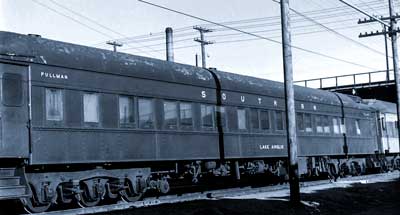
A Classic Pullman 10-1-2 Sleeper
The Lake Ainslie was built to Pullman Plan No. 3585, Lot No. 4728, with a configuration commonly described as a 10-1-2 sleeper. This designation refers to its ten open sections, one drawing room, and two compartments.
The open sections provided economical sleeping accommodations, with facing seats that could be converted into a lower berth at night and an upper berth that folded down from above. Curtains provided privacy while passengers slept.
For travelers seeking greater privacy, the car offered two compartments and a drawing room. These enclosed accommodations provided an alternative to the open sections, with the drawing room featuring its own private lounge area.
At one end of the open-section area was a large men's lavatory with a separate "saloon," or toilet annex. A similarly arranged women's lavatory and saloon occupied the opposite end of the car.
The Lake Ainslie was originally constructed without air conditioning, a feature that was added on June 19, 1936.
What's in a Name?
The Lake Ainslie belonged to a series of 244 Pullman sleeping cars named for actual lakes. Within that series, Lake Ainslie was the first name alphabetically, while Lake Zurich was the last.
The names represented nearly every letter of the alphabet, with only X and Y omitted. Many letters appeared multiple times throughout the series.
Although each car carried its own name, the Lake-series sleepers shared a standardized design that made them a familiar sight on passenger trains throughout the country.
From Pullman to Southern Railway
Like other sleeping cars of its generation, the Lake Ainslie was originally owned and operated by the Pullman Company rather than by an individual railroad.
The car generally operated in Pullman's pool service, meaning it could be assigned to different railroads and trains as needed. In practice, such cars often worked on the same routes or for the same railroads over extended periods.
Following the United States v. Pullman Co. antitrust proceedings of 1940–1947, the ownership of Pullman's sleeping-car fleet underwent a major change. Many cars were sold to the railroads on which they operated.
In 1948, the Lake Ainslie was sold to Southern Railway. Southern, in turn, leased its Pullman-built sleeping cars back to the Pullman Company, which continued operating them.
Preservation at the Heart of Dixie
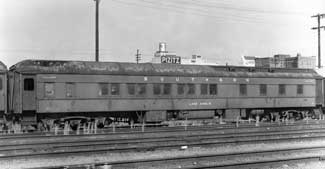 By the mid-1960s, the era of traditional heavyweight Pullman sleeping cars was drawing to a close. Southern Railway elected to retire the Lake Ainslie, and the car was donated to the Heart of Dixie Railroad Museum around 1966. A photograph documents its arrival at the museum in November 1965.
Its preservation is particularly significant because the Lake Ainslie represents one of Pullman's largest sleeping-car series and one of the company's most widely used floor plans.
Unlike an unusually appointed private car, the Lake Ainslie illustrates the accommodations available to ordinary travelers who chose Pullman service. Passengers could select the relative economy of an open section or the greater privacy of an enclosed room, making long-distance travel more comfortable than remaining seated in a coach overnight.
Preserving the Pullman Experience
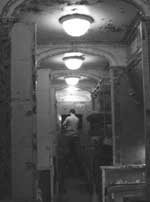 For much of the early 20th century, sleeping cars such as the Lake Ainslie were an essential part of long-distance passenger railroading. They allowed travelers to cover hundreds of miles overnight while enjoying accommodations designed specifically for rest and comfort.
The Lake Ainslie preserves more than a historic railroad car. Its surviving arrangement of sections, compartments, and shared facilities offers a tangible connection to the way Americans once traveled.
As one of the Heart of Dixie Railroad Museum's notable pieces of passenger equipment, the Lake Ainslie provides an opportunity to understand the craftsmanship, practicality, and distinctive character of Pullman sleeping-car travel during the height of America's passenger railroad era.