Built in 1948 for the Missouri Pacific Railroad, Dome Coach No. 892 was one of three distinctive "Planetarium Dome" cars designed to give passengers an elevated view of the passing scenery. Originally assigned to the railroad's celebrated Eagle passenger trains, the car later served the Illinois Central before becoming part of the Heart of Dixie Railroad Museum's collection in 1972.
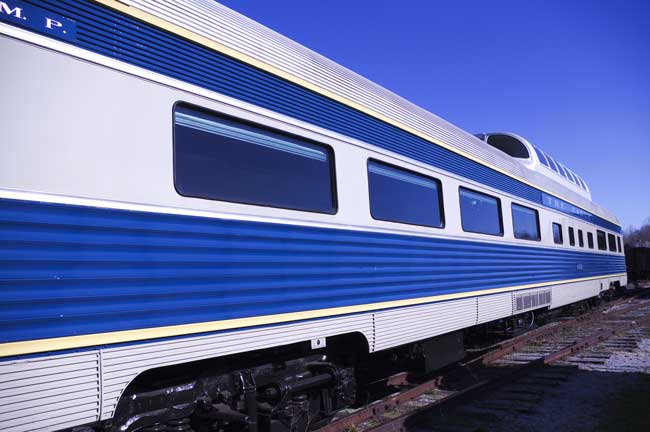
Today, No. 892 retains much of its original configuration and wears the blue, white, gold, and silver colors of its Missouri Pacific heritage.
Built for the Eagle Fleet
In June and July 1948, the Edward G. Budd Company completed three Planetarium Dome coaches for the Missouri Pacific Railroad. Numbered 890, 891, and 892, the cars were part of a $14 million investment in the railroad's Eagle passenger fleet.
During the streamliner era, railroads adopted distinctive names for their dome cars. Missouri Pacific called its three cars "Planetarium Domes," emphasizing the panoramic views available from their elevated seating areas.
The Colorado Eagle
The Colorado Eagle was an overnight passenger train operating between St. Louis, Missouri, and Denver, Colorado, by way of Pueblo and Colorado Springs.
The train's consist included three sleeping cars, a standard coach, a grill coach, a diner-lounge car, and a Planetarium Dome coach.
Three complete train consists were required to maintain the service, with one dome coach assigned to each consist. The arrangement ensured that passengers could enjoy the distinctive dome-car experience on every departure.
The Eagle Paint Scheme and Assignments
Missouri Pacific's dome coaches were painted to match the other cars in the Eagle fleet. Their striking exterior colors combined blue and white with gold and silver striping, while the vestibules retained a stainless-steel finish.
Although all three cars were originally intended for the Colorado Eagle, their lettering reflected differences in how the railroad planned to use them.
Nos. 890 and 891 carried the name Colorado Eagle on their letterboards and were assigned primarily to that train. No. 892, however, carried the more general name The Eagle, allowing it to operate on the Texas Eagle and Missouri River Eagle as well.
By 1952, Missouri Pacific had changed the letterboards on Nos. 890 and 891 to read The Eagle, giving the railroad greater flexibility in assigning all three dome coaches throughout its passenger network.
Renumbering and Later Missouri Pacific Service
Between February and June 1963, Missouri Pacific undertook a general renumbering of its lightweight passenger equipment.
As part of the program, Planetarium Dome coaches Nos. 890, 891, and 892 became Nos. 590, 591, and 592, respectively.
In 1964, declining passenger traffic led Missouri Pacific to downgrade the Colorado Eagle. The dome coaches were reassigned to the Missouri River Eagle, which operated between Omaha, Nebraska, and St. Louis, Missouri.
The cars also appeared on trains Nos. 21 and 22, operating between Fort Worth, Texas, and New Orleans, Louisiana.
Service on the Illinois Central
In June 1967, Missouri Pacific sold all three Planetarium Dome coaches to the Illinois Central Railroad.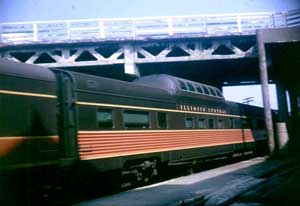
Illinois Central planned to use the cars on two of its passenger trains: the City of Miami, operating between Chicago, Illinois, and Miami, Florida, and the City of New Orleans, operating between Chicago and New Orleans, Louisiana.
Under Illinois Central ownership, the dome coaches received the railroad's chocolate-and-orange exterior paint scheme.
The railroad also renumbered the cars. Former Missouri Pacific Nos. 590, 591, and 592 became Illinois Central Nos. 2200, 2201, and 2202, respectively.
Thus, the car originally built as Missouri Pacific No. 892 became Illinois Central No. 2202.
Acquired by the Heart of Dixie Railroad Club
In 1972, the Illinois Central sold No. 2202 to the Heart of Dixie Railroad Club in Birmingham, Alabama.
Following its acquisition, the club repainted the car metallic burgundy with gold striping and Heart of Dixie lettering. In this appearance, the former Planetarium Dome coach operated on various club-sponsored railroad excursions.
The acquisition preserved an important example of the dome-car design that had become a hallmark of American streamlined passenger trains.
Interior Restoration, 1988–1989
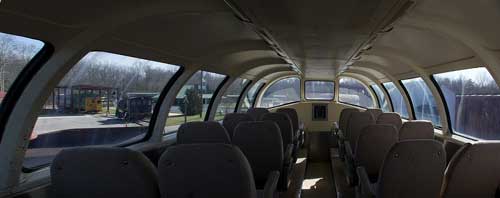
During 1988 and 1989, the Heart of Dixie undertook a cosmetic restoration of the car's interior.
Volunteers replaced the black-and-silver vinyl seat coverings installed during Illinois Central ownership with new tan fabric upholstery. The interior was also repainted, and numerous windows were replaced.
Particular attention was given to the dome's distinctive teardrop-shaped corner windows and its forward- and rear-facing windows. When the museum acquired the car, these windows had been covered with metal plates.
The restoration returned much of the dome's original visibility, allowing passengers to once again enjoy the elevated views for which the car had been designed.
The Mystery of the Plated-Over Windows
The upper portions of the dome windows remain plated over.
According to an account associated with the car's Illinois Central service, the railroad covered these windows after children reportedly threw blocks from bridges onto passing trains in the Chicago area, breaking the dome glass.
Although the explanation has not been independently documented in the museum's account, it remains an unusual detail in the car's history.
Restoring the Missouri Pacific Appearance
In 2015, the Heart of Dixie Railroad Museum completed an exterior cosmetic restoration that returned the car to its original Missouri Pacific identity as No. 892.
The work recreated the blue-and-white paint scheme with gold and silver striping that the car wore during its early years in Eagle service.
The Missouri Pacific Historical Society provided valuable assistance, including historical information and paint samples that helped the museum reproduce the car's original exterior appearance accurately.
The museum extends its thanks to the Missouri Pacific Historical Society for its assistance with the restoration.
A Surviving Planetarium Dome
Missouri Pacific No. 892 is a notable survivor because it retains much of its original dome-coach configuration.
Many surviving dome cars have been extensively modified, either for dining-car service or to meet the requirements of later Amtrak operations. No. 892, by comparison, remains a representative example of the equipment built for Missouri Pacific's postwar passenger fleet.
From the Colorado Eagle and Missouri River Eagle to Illinois Central service and preservation in Alabama, No. 892 reflects the history of the dome car as one of the most recognizable innovations of the streamlined passenger era.