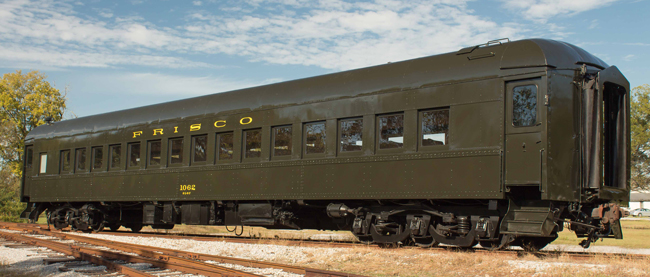
Built in 1910 for the St. Louis–San Francisco Railway, better known as the Frisco, Coach No. 1062 has carried passengers for more than a century. From its early years as a heavyweight coach to its modernization for the Firefly streamliner, the car reflects a changing era in American passenger railroading. Since 1968, it has also been an important part of the Heart of Dixie Railroad Museum's history.
A Modern Coach for the Frisco
In September 1910, American Car & Foundry completed construction of No. 1062, one of 12 all-steel, 60-seat coaches built for the St. Louis–San Francisco Railway. Numbered 1052 through 1063, the cars were constructed under lot No. 5522.
The new coaches represented a significant improvement over earlier wooden passenger equipment. Known as heavyweight cars, they featured steel frames, sides, and roofs, providing a smoother ride than the wooden coaches supported by truss-rod bracing. For Frisco passengers, No. 1062 offered the latest in coach comfort and construction.
Original Construction and Specifications
As built, No. 1062 featured a clerestory roof, with a raised center section providing ventilation and natural light. Like other passenger cars of its era, it was not equipped with air-conditioning.
The car rode on six-wheel trucks with 36-inch-diameter wheels and 5-by-9-inch journals. Its principal dimensions were:
- Width over side sills: 10 feet, 3 inches
- Length over end sills: 70 feet, 1 inch
- Overall length over buffers: 79 feet, 6¾ inches
- Truck centers: 54 feet, 1 inch
- Total wheelbase: 65 feet, 1 inch
- Overall height over ventilators: 14 feet, 6 inches
Three Decades Across the Frisco System
For the next 32 years, No. 1062 carried passengers across the Frisco's extensive Midwestern and Southern routes. The railroad served Missouri, Kansas, Arkansas, Oklahoma, Texas, Tennessee, Mississippi, and Alabama.
Among the major cities on the Frisco system were St. Louis, Kansas City, Springfield, Memphis, Tulsa, Fort Smith, Oklahoma City, Dallas, Fort Worth, Birmingham, and Mobile.
The Firefly
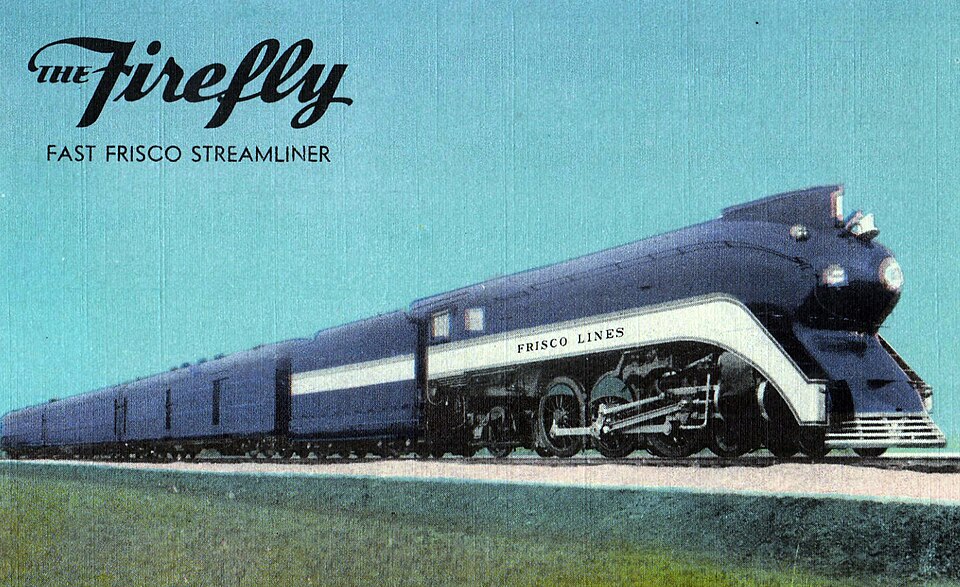
As streamlined passenger trains gained popularity during the late 1930s, the Frisco developed a streamliner of its own. The Firefly entered service on December 10, 1939, operating between Kansas City, Tulsa, and Oklahoma City.
Rather than purchasing an entirely new train, the railroad modernized conventional passenger equipment at its Springfield shops. The resulting train featured a striking blue-and-silver paint scheme and was powered by streamlined Pacific-type steam locomotives. Its consist included coaches such as No. 1026.
The Firefly averaged 52.3 mph over its 379-mile route, demonstrating that modernized conventional equipment could provide competitive passenger service during the streamliner era.
Modernized for Streamliner Service
In April and May 1942, Frisco's Springfield shops modernized No. 1062 for service on the Firefly. The rebuilding included new passenger seats, improved lighting, and the installation of air-conditioning.
Accommodating the new air-conditioning ductwork required a substantial change to the car's appearance. The original clerestory roof was replaced with a rounded turtleback roof, providing space for the ductwork above the passenger compartment.
A Waukesha Ice Engine was installed beneath the car. This refrigeration system used a compressor and water chiller powered by a propane engine to provide air-conditioning.
Exterior skirting was also added beneath the car body to give the heavyweight coach a more streamlined appearance. The car received the Firefly's distinctive dark-blue paint with a silver window band.
Frisco promoted the modernized heavyweight equipment as being "heavier than ordinary streamliners ... resulting in smoother riding."
Later Years on the Frisco
Details of No. 1062's assignments during its later Frisco years are unavailable. The car probably operated on several Frisco passenger trains during the 1950s and 1960s.
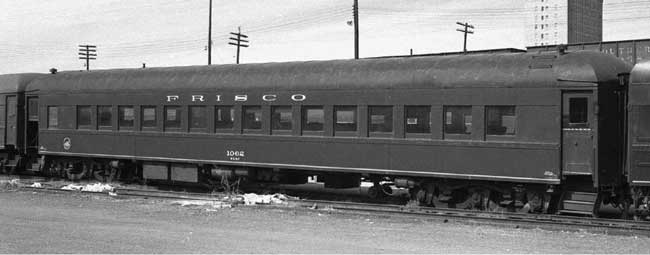
By the late 1960s, No. 1062 had been repainted in plain Pullman Green, the color it wears today. Its streamlined skirting had also been removed, most likely to simplify access to equipment beneath the car for maintenance.
Donated to the Heart of Dixie
On May 24, 1968, the Frisco formally presented Coach No. 1062 to the Heart of Dixie Railroad Museum. The donation began a new chapter in the car's history, preserving an example of early all-steel passenger equipment that had also participated in the streamliner era.
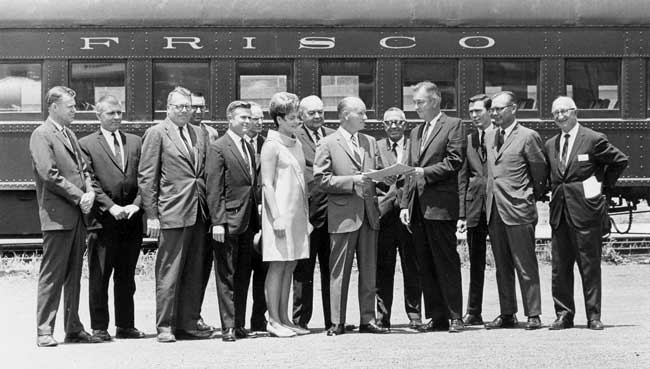
At the museum's former Powell Avenue location in Birmingham, No. 1062 retained its Pullman Green paint scheme. Photographs from this period show the coach without the streamlined skirting installed during its Firefly years.
Restored by Museum Volunteers
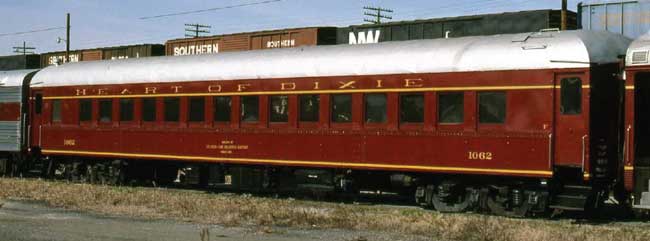
In 1985, Heart of Dixie volunteers completed a major restoration of No. 1062 following several years of work. The exterior was repainted metallic burgundy with gold striping and lettering, while the interior received new paint, flooring, and upholstery.
The restored coach became a particular source of pride for the museum and its volunteers, demonstrating what could be accomplished through their dedication to preserving historic railroad equipment.
Mainline Excursions and Changing Requirements
During its early years with the Heart of Dixie Railroad Museum, No. 1062 operated on mainline excursion trains. Continued operation required several mechanical improvements as railroad safety and equipment standards changed.
The car's original UC brake valve was replaced with a modern ABDW brake system. Following a derailment involving a Norfolk Southern excursion train, tightlock couplers became a requirement for equipment operating in mainline excursion service. These couplers were also installed on No. 1062.
Ultimately, restrictions on friction-bearing equipment brought an end to the coach's mainline excursion career.
In May and June 1989, No. 1062 participated in the weeklong Alabama Reunion Special, traveling across the state. It became one of the last friction-bearing passenger cars to operate over CSX or Norfolk Southern lines.
During that excursion, the Frisco coach was regarded as the coolest and smoothest-riding car in the train, much to the pride of the Heart of Dixie crew.
A Return to Regular Passenger Service
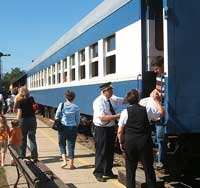
When the Heart of Dixie Railroad Museum began operating the Calera & Shelby Railroad in the fall of 1994, No. 1062 returned to regular passenger service.
The car operated as an open-window coach because its original Waukesha Ice Engine air-conditioning system was considered impractical to operate under modern conditions.
In subsequent years, volunteers continued maintaining and improving the coach, including replacing its windows and upholstery.
More Than a Century of Passenger Service
From its construction in 1910 through decades of service with the Frisco and the Heart of Dixie Railroad Museum, No. 1062 has carried generations of passengers.
Its history includes 57 years with the Frisco and more than 43 years with the museum. The total number of passenger miles accumulated during that time may never be known.
More than a surviving heavyweight coach, No. 1062 tells the story of changing passenger-car technology, the streamlined era, and the volunteers who have preserved it for future generations.
With continued care, perhaps this remarkable car will one day celebrate its second centennial.