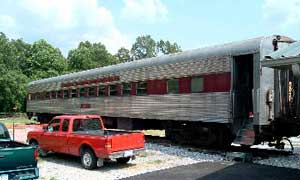
Built in 1950 by the Pullman-Standard Car Manufacturing Company, Chair Car No. 2931 was designed for one of the Santa Fe Railway's most celebrated passenger trains, the El Capitan. With seating for 44 passengers, the car offered a level of comfort intended to make long-distance travel enjoyable without the expense of a sleeping-car accommodation.
No. 2931 was one of 34 chair cars ordered by the Atchison, Topeka and Santa Fe Railway in February 1948. Deliveries began in March 1950 and continued through July of that year.
The El Capitan
Santa Fe ordered No. 2931 specifically for service aboard the El Capitan, America's first and only deluxe all-chair-car transcontinental train. Operating between Chicago and Los Angeles, the train completed its journey in just 39 hours and 45 minutes.
The El Capitan operated over the same route and on the same fast schedule as Santa Fe's premier all-Pullman sleeping-car train, the Super Chief. Unlike its more luxurious companion, however, the El Capitan offered chair-car accommodations rather than Pullman sleeping compartments.
Santa Fe deliberately used the term chair car instead of coach to distinguish its long-distance accommodations from those found in conventional passenger cars.
A typical coach might have only a footrest and limited seat-back adjustment. By comparison, the El Capitan's chair cars featured reclining seats with extending leg rests, allowing passengers to travel greater distances in comfort.
Santa Fe intended these cars to remain in long-distance service throughout their working lives, making passenger comfort a central consideration in their design.
Ride-Master Seats and Passenger Comfort
 All 34 cars in the order were equipped with Ride-Master seats, specially designed for long-distance passenger travel. Foam rubber cushions were molded to body measurements, while full-length leg rests folded neatly beneath the seats when not in use.
The upholstered armrests incorporated fingertip controls that allowed passengers to adjust the seat backs to three reclining positions.
Window spacing was also redesigned to provide passengers with better views than those available in earlier coaches.
Considerable attention was given to the interior finishes. Carpeting featured tones inspired by the desert sands of the American Southwest, while walls and ceilings were finished in soft pastel colors.
To avoid a monotonous appearance, color combinations varied from car to car. These included old rose with red, buff with tans, and olive with gray-greens. Stainless steel and chrome trim provided contrasting accents, while Flexwood veneers finished the sidewalls throughout the cars.
Soft indirect lighting complemented the interiors, and individual reading lights above the seats allowed passengers to read without disturbing their neighbors.
Amtrak Service
 Chair Car No. 2931 remained in Santa Fe passenger service until 1971, when the railroad discontinued its passenger operations because they were no longer profitable.
On April 16, 1971, Santa Fe signed an agreement transferring its passenger train names and 450 pieces of passenger equipment, including No. 2931, to the newly established National Railroad Passenger Corporation, better known as Amtrak.
Santa Fe's equipment represented a substantial portion of Amtrak's original passenger car fleet. Amtrak continued using the El Capitan name until 1973.
Under Amtrak ownership, No. 2931 was renumbered No. 4534 and remained in service until 1982.
Preservation at the Heart of Dixie
The Heart of Dixie Railroad Museum acquired the former Santa Fe chair car at an Amtrak equipment auction in 1982.
One of the museum's first changes was relatively simple: restoring the car's original Santa Fe number, 2931.
A more substantial modification involved replacing the original fixed windows with sash windows that could be raised. The change was necessary because the car's air-conditioning system was steam-powered rather than electric, making the original system unsuitable for the museum's operating conditions.
Although this modification altered part of the car's original appearance, it allowed No. 2931 to continue carrying passengers in excursion service.
Today, Chair Car No. 2931 preserves a connection to the era when Santa Fe's El Capitan demonstrated that long-distance rail travel could offer speed, comfort, and style without the expense of a Pullman sleeping car.