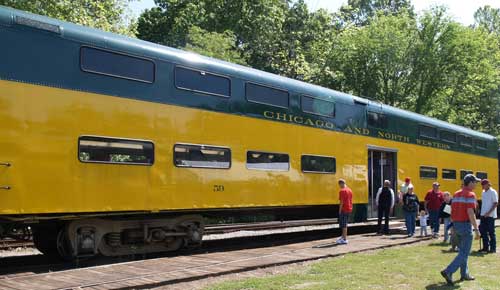
 Built in 1960 by Pullman-Standard for the Chicago and North Western Railway (C&NW), gallery cars Nos. 59 and 64 were part of a new generation of commuter equipment designed to improve efficiency, increase passenger capacity, and reduce operating costs. The two cars later served Chicago-area commuters as Metra Nos. 7710 and 7715 before coming to the Heart of Dixie Railroad Museum.
The cars were built as part of a $21 million order for 116 bi-level commuter cars equipped for push-pull operation. Originally numbered C&NW 59 and 64, they were later renumbered 7710 and 7715, respectively, during their years in Chicago-area commuter service.
Chicago and North Western management had determined that making commuter operations profitable would require a different approach to passenger equipment. The new bi-level cars brought together several design innovations intended to move more passengers while reducing the time and expense of operating commuter trains.
Modern Design Innovations
One of the most noticeable innovations was the center-door arrangement. By allowing passengers to board and leave through doors near the middle of the car, the design reduced loading and unloading times. Shorter station stops, in turn, helped the railroad maintain faster commuter schedules.
The cars also relied on head-end power for their electrical needs, including heating, air-conditioning, and lighting. Rather than carrying individual generators beneath each car, electrical power was supplied from the locomotive or another source in the train.
Eliminating the onboard generator equipment saved approximately 10 tons in weight, simplified maintenance, and freed valuable space beneath the car. This was particularly important in accommodating the bi-level seating arrangement.
Another major innovation was push-pull operation. Chicago and North Western's Chicago terminal had stub-end tracks, making it necessary to perform expensive and time-consuming switching movements to turn conventional commuter trains for their return trips.
With push-pull operation, a locomotive remained at one end of the train while a specially equipped bi-level car with a control cab occupied the other. The engineer could operate the train from either end, eliminating the need to turn the entire train at the terminal.
Gallery Seating
Bi-level construction substantially increased passenger capacity, but it also presented a problem for conductors collecting fares. On conventional two-level equipment, conductors had to make separate trips through the lower and upper seating areas.
With short distances between commuter stations, conductors sometimes could not reach every passenger before the next stop. As a result, some fares went uncollected.
The gallery design offered a practical solution. Instead of providing two completely separate floors, the upper seating areas were arranged as open galleries overlooking a central aisle on the lower level.
This arrangement allowed conductors to collect fares from passengers on both levels during a single pass through the car, improving efficiency while preserving the increased seating capacity of the bi-level design.
Maximum Comfort, Minimum Maintenance
The interior of No. 59, later Metra No. 7710, remains essentially as it was when built in 1960. Chicago and North Western designed the interiors to provide passenger comfort while keeping cleaning and maintenance requirements to a minimum.
The railroad even claimed that the interiors could theoretically be cleaned with a water hose. Walls and ceilings were finished with easy-to-clean, scuff-resistant vinyl bonded to steel. Window frames were also made of vinyl and featured rounded corners to make cleaning easier.
The original interior color scheme combined cream and cool blue. Five-foot-wide windows were fitted with gradually tinted, heat-absorbing glass, eliminating the need for conventional blinds or shades.
Passenger seats were upholstered in coral-colored vinyl and padded with foam rubber. Fluorescent lighting illuminated the passenger compartments, while incandescent lamps provided emergency lighting.
Together, these features reflected the railroad's effort to provide comfortable, modern commuter accommodations without the maintenance demands associated with older passenger equipment.
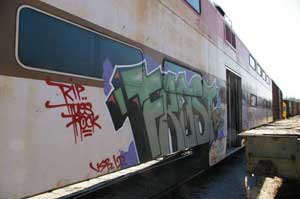
Pullman-Standard Lot No. 7002
Between 1960 and 1970, Chicago and North Western ordered 231 bi-level commuter coaches in eight separate lots. The fleet included 28 coaches seating 168 passengers, 139 coaches seating 161 passengers, and 64 coaches seating 155 passengers that were equipped with control cabs.
Nos. 59 and 64 belonged to the group of 161-seat coaches. Both were built as part of Pullman-Standard lot No. 7002.
All 231 cars were constructed to Pullman-Standard plan W-53194 at the company's Worcester, Massachusetts, plant. The cars featured girder construction, smooth exterior sides, and type 41-HL-11 (CIB) trucks.
During their Chicago and North Western service, the cars wore the railroad's familiar green and yellow paint scheme.
Regional Transportation Authority and Metra
Chicago and North Western operated Nos. 59 and 64, along with their sister cars, in Chicago-area commuter service for many years.
In 1978, the Regional Transportation Authority (RTA) assumed responsibility for the commuter operations formerly provided by Chicago and North Western. Commuter services operated by several Chicago-area railroads were eventually brought together under the Metra system.
Metra, a name derived from Metropolitan Rail, continues to provide commuter rail service in northeastern Illinois.
During their later commuter careers, C&NW Nos. 59 and 64 carried the numbers 7710 and 7715, respectively.
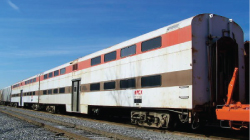
In Service as Late as 2005
Evidence of the cars' later years in commuter service remained aboard when the museum acquired them. Copies of Metra's employee newsletter, On the Bi-Level, were found inside Nos. 59 and 64, indicating that the cars had remained in Metra service as recently as February 2005.
By 2009, both cars had been placed in storage and were no longer in regular service.
Representatives of the Heart of Dixie Railroad Museum traveled to Kansas City to inspect the cars and subsequently recommended their purchase. In July 2009, the museum's Board of Trustees voted to acquire Nos. 7710 and 7715.
Transportation to Alabama proved less straightforward than anticipated. After numerous delays and several telephone calls, the two cars arrived at the museum in February 2010.
Restoration at the Heart of Dixie
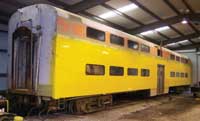 Following their arrival, museum volunteers began preparing No. 59 for service on the Calera & Shelby Railroad, with the goal of having it ready for the museum's annual North Pole Express.
The work included rebuilding the air-operated center doors, replacing the green-tinted lower-level windows with clear glass, and replacing lighting ballasts and bulbs.
Volunteers also prepared and repainted the exterior, returning the car to its original Chicago and North Western green and yellow appearance.
The restoration schedule was tight. The paint was barely dry when No. 59 made its Calera & Shelby Railroad debut during North Pole Express.
Today, No. 59 closely resembles its appearance when it entered Chicago and North Western service in 1960.
Riding Aboard No. 59
Gallery car No. 59 offers a distinctive passenger experience. Its seating is arranged in groups of four facing one another, making the car particularly well suited to families traveling together.
Passengers board through a center vestibule that divides the car into two sections, identified as the A End and B End.
During North Pole Express, the A End serves as the performance area for the museum's live entertainers, adding to the festive atmosphere aboard the train.
The upper gallery seating areas are not available during North Pole Express, although they may be used during certain other museum events.