Not every locomotive needs hundreds of horsepower to perform important railroad work. Sometimes, a small, dependable switcher is exactly what's needed to move equipment around a railroad yard or maintenance facility.
At the Heart of Dixie Railroad Museum, that job belongs to Whitcomb 25-ton No. 2, affectionately known as the "Shop Goat." Built in 1951 for the United States Air Force, this compact diesel-electric locomotive eventually found a new home in Calera, Alabama, where it continues the kind of work for which it was originally designed.
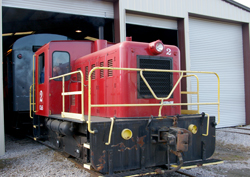
Built for the United States Air Force
Whitcomb Locomotive Company constructed the locomotive in December 1951 at its plant in Rochelle, Illinois. At the time, Whitcomb was a subsidiary of Baldwin Locomotive Works, one of America's best-known locomotive manufacturers.
Originally built for the United States Air Force, the locomotive carried road number 1140. Its original appearance featured a black frame, blue cab and hood, and white lettering.
Small industrial locomotives such as No. 1140 were well suited to switching railroad cars within military installations, manufacturing plants, and other facilities where space was limited and frequent short movements were required.
A Compact Diesel-Electric Switcher
No. 2 is a four-wheel, 25-ton diesel-electric locomotive classified by Whitcomb as a Class 25DE26. Its builder's serial number is 61184.
Power is supplied by a Cummins Model HBI diesel engine driving a Westinghouse generator. The generator produces electricity for the locomotive's traction motors, which turn the wheels.
Although considerably smaller than the museum's road and yard-switching locomotives, No. 2 is capable of moving railroad equipment at the low speeds required for switching and maintenance work.
The locomotive weighs 50,850 pounds, approximately 25 tons, giving it the weight and traction needed for its intended assignments.
Why Is It Called a "Shop Goat"?
Railroaders have long used the nickname "goat" for small switching locomotives. Like their namesake animals, these compact engines can be useful in places where larger equipment would be less practical.
The term "shop goat" is especially appropriate for a locomotive assigned to move equipment around maintenance facilities and railroad yards.
At the Heart of Dixie Railroad Museum, No. 2 carries on that tradition, performing the less glamorous but essential work that helps keep a railroad operating.
Donated to the Heart of Dixie Railroad Museum
Following its industrial service, No. 2 was donated to the Heart of Dixie Railroad Museum by Monsanto Chemical Company in 1993.
A presentation ceremony was held at Monsanto's plant on June 10, 1993. The donation was formally recorded on June 25 of that year.
Just over a month later, on July 27, 1993, the locomotive arrived at its new home in Calera, Alabama, at precisely 9:20 a.m.
The museum's original records preserve that unusually specific arrival time, marking the beginning of another chapter in the locomotive's working life.
Still Earning Its Keep
Unlike many historic locomotives preserved primarily for display, Whitcomb No. 2 has continued to serve a practical purpose at the Heart of Dixie Railroad Museum.
Known to museum volunteers as the "Shop Goat," it remains part of the museum's working equipment, helping with the movement of railroad cars and other equipment as needed.
Its preservation demonstrates that railroad history isn't limited to the large locomotives that hauled passenger and freight trains across the country. Smaller industrial switchers played an equally necessary role behind the scenes, moving equipment and supporting the daily work of railroads, factories, and military installations.
More than seven decades after its construction, Whitcomb No. 2 remains a reminder that even the smallest locomotive can make a valuable contribution to railroad operations.