In the 1930s, railroads across America began replacing steam locomotives with diesel-electric power, particularly for switching freight cars in busy railroad yards and industrial facilities. Among the early adopters was the Birmingham Southern Railroad, which served the steel mills, foundries, and manufacturing plants of Alabama's Birmingham industrial district.
One of the locomotives acquired during that transition was Birmingham Southern No. 82, an American Locomotive Company (ALCO) HH900 diesel-electric switcher built in March 1937. After more than two decades with Birmingham Southern, the locomotive began a second career with American Cast Iron Pipe Company (ACIPCO), where it worked for approximately another 20 years.
Now preserved at the Heart of Dixie Railroad Museum, No. 82 represents an important chapter in Alabama's industrial railroad history and the early development of diesel-electric locomotives.
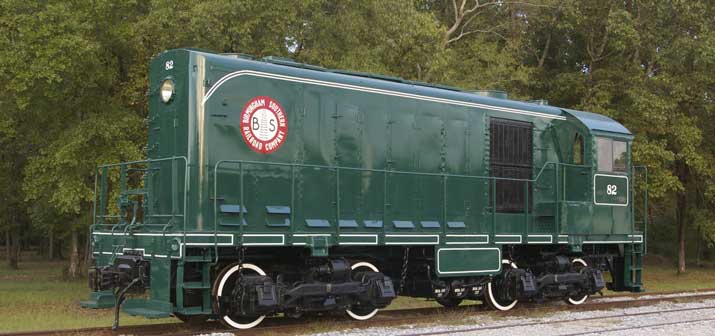
Built for Birmingham Southern
ALCO constructed No. 82 at its Schenectady, New York, plant in March 1937 under builder's number 68788. The locomotive was delivered to the Birmingham Southern Railroad as part of the railroad's effort to replace steam power with diesel locomotives.
During 1937, Birmingham Southern purchased five ALCO HH900 locomotives and five Electro-Motive Corporation (EMC) NC switchers. The railroad subsequently added three more HH900s, numbered 86 through 88.
The HH900 designation reflected the locomotive's high-hood body style and 900-horsepower rating. These locomotives were designed primarily for switching service, but their multiple-unit controls also allowed two or more units to operate together in transfer service.
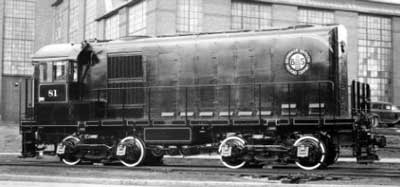
Supercharged Diesel Power
The HH900 was an early example of a purpose-built diesel-electric switching locomotive. Its compact dimensions, substantial weight, and high starting tractive effort made it well suited to moving heavy freight cars within industrial complexes and railroad yards.
No. 82 was powered by a McIntosh & Seymour Model 6-53T supercharged diesel engine producing 900 horsepower. The locomotive was equipped with Westinghouse electrical equipment.
Measuring 43 feet, 3 inches long and weighing approximately 115 tons, the HH900 developed a starting tractive effort of 69,000 pounds. That pulling force was particularly valuable when starting heavy cuts of loaded freight cars from a standstill.
More Than Two Decades of Service
No. 82 spent over two decades working for Birmingham Southern before the railroad began replacing its aging high-hood diesel switchers with newer locomotives.
The locomotive's surviving inspection cards indicate that Birmingham Southern last operated No. 82 in 1962.
During its Birmingham Southern years, No. 82 wore more than one paint scheme. Its final appearance on the railroad featured a green body with a broad yellow stripe and black lettering.
The original paint scheme is believed to have been dark green with white pinstriping and lettering, although no color photograph has been located to confirm that appearance.
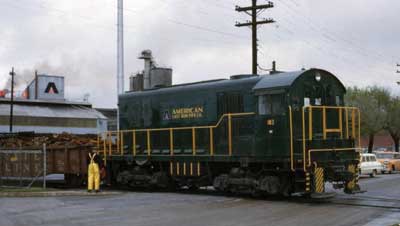
A Second Career at ACIPCO
In 1963, Birmingham Southern sold Nos. 81 and 82 to one of its industrial customers, American Cast Iron Pipe Company (ACIPCO) in Birmingham.
ACIPCO renumbered the locomotives No. 101 and No. 103, respectively. The former Birmingham Southern No. 82 became ACIPCO No. 103.
The locomotives initially wore a plain green paint scheme. Later, ACIPCO repainted them in a distinctive red, white, and blue design.
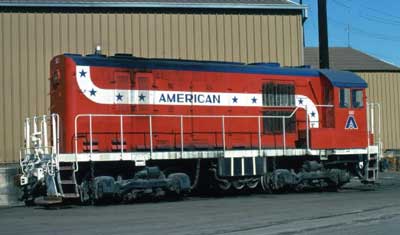
For approximately two more decades, No. 103 handled carloads of cast iron pipe within ACIPCO's industrial railroad operations.
Despite its age, the locomotive remained in service long after many other early diesel switchers had been retired. During its final working years, No. 103 was recognized as the second-oldest operating diesel locomotive in the United States.
Retirement and Preservation
No. 103's long operating career eventually ended when the locomotive suffered a broken crankshaft. The mechanical failure brought an end to decades of service that had begun with Birmingham Southern in 1937.
Following its retirement, ACIPCO donated the locomotive to the Heart of Dixie Railroad Museum, preserving an important example of early diesel-electric technology and Alabama industrial railroad history.
As Birmingham Southern No. 82 and later ACIPCO No. 103, the locomotive spent its working life serving the industries that helped establish Birmingham as one of the South's major manufacturing centers.
Today, the museum's ALCO HH900 stands as a reminder of the transition from steam to diesel power and the remarkable longevity of some of America's earliest diesel-electric locomotives.