Fairbanks-Morse built some of the most distinctive diesel-electric locomotives of the mid-20th century. While other manufacturers relied on more conventional diesel engines, Fairbanks-Morse developed locomotives powered by an unusual opposed-piston engine design. The technology had already proven itself aboard U.S. Navy submarines during World War II before finding a new application on American railroads.
The Heart of Dixie Railroad Museum's Fairbanks-Morse H12-44 No. 1850 is an example of that engineering heritage. Built in early 1953, the 1,200-horsepower locomotive was designed for switching railroad cars in yards and handling lighter freight assignments. It later became part of the museum's operating fleet, hauling excursion trains on the Calera & Shelby Railroad.
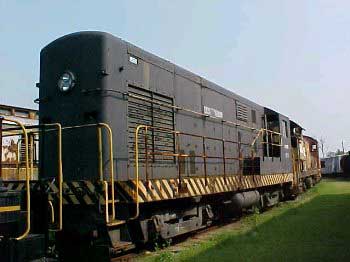
Built for Switching and Light Freight
No. 1850 was constructed during January and February 1953 as part of a group of 20 H12-44 locomotives.
Weighing approximately 120 tons, the locomotive was equipped with two four-wheel trucks, giving it a B-B wheel arrangement. Each of its four axles was powered by an electric traction motor.
The H12-44 could develop a starting tractive effort of 40,440 pounds-force and was capable of speeds up to 60 miles per hour. This combination of pulling power and speed made the model suitable for yard switching as well as lighter freight service.
Understanding the H12-44 Designation
Fairbanks-Morse used a straightforward system to identify its locomotive models. The designation H12-44 describes several of the locomotive's principal characteristics:
- H identifies the locomotive as a hood unit.
- 12 represents its 1,200-horsepower rating.
- 44 indicates four powered axles and four traction motors.
The result was a compact, powerful locomotive intended for the frequent starts, stops, and heavy pulling demands of railroad switching.
From Submarines to Locomotives
One of the most unusual features of Fairbanks-Morse locomotives was their connection to the United States Navy. During the 1930s, the company developed its Model 38 opposed-piston diesel engine, a compact but powerful design that proved particularly well suited to submarine propulsion.
During World War II, Fairbanks-Morse engines powered numerous American submarines and other naval vessels. Nearly 2,300 engines were manufactured for the Navy, establishing a reputation for dependable service under demanding conditions.
In 1944, Fairbanks-Morse entered the diesel locomotive market, adapting its proven opposed-piston engine technology for railroad use. The same basic engine family that had powered submarines beneath the ocean now supplied the horsepower needed to move freight cars and trains across America's railroads.
The museum's H12-44 No. 1850 is a descendant of that naval engineering tradition. Its six-cylinder opposed-piston engine reflects a design whose history reaches from World War II submarines to the railroad yards of the 1950s.
An Unusual Opposed-Piston Diesel Engine
At the heart of No. 1850 is a six-cylinder Fairbanks-Morse Model 38D8-1/8 two-stroke, opposed-piston diesel engine, rated at 1,200 horsepower.
Unlike a conventional diesel engine, which uses one piston in each cylinder working against a fixed cylinder head, the Fairbanks-Morse design uses two pistons moving toward and away from one another within the same cylinder. Combustion occurs in the space between the opposing pistons.
The engine has six cylinders, each with an 8⅛-inch bore. Its opposed pistons are connected to separate crankshafts at the top and bottom of the engine, which are mechanically linked to deliver power.
This arrangement eliminates the need for conventional cylinder heads and their associated valve gear. Although mechanically more complex in some respects, the design offered advantages in power output and efficiency that made it attractive for both marine and railroad applications.
Fairbanks-Morse's Most Successful Diesel Model
The H12-44 became Fairbanks-Morse's most successful diesel locomotive model. Nearly 400 were constructed during an eleven-year production period.
Despite the complexity of their engines, H12-44 locomotives earned a reputation for their ability to handle demanding switching assignments. Their combination of relatively modest size and substantial pulling power made them useful in railroad yards and industrial operations.
Although Fairbanks-Morse ended locomotive production in 1963, the company continued developing and manufacturing opposed-piston engines for marine and other applications.
Service at the Heart of Dixie Railroad Museum
No. 1850 served for a number of years as one of the locomotives powering excursion trains at the Heart of Dixie Railroad Museum.
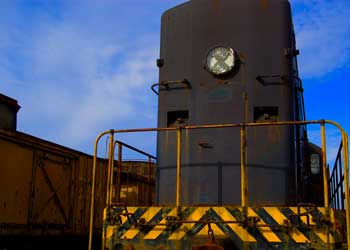
As the museum's operating fleet developed, EMD SW8 locomotives eventually took over the assignments previously handled by No. 1850.
The Fairbanks-Morse locomotive is now retired from regular operation. Although it is not currently serviceable, the museum's original account identifies the possibility of returning it to service following appropriate mechanical repairs.
Such a restoration could allow No. 1850 to serve as a locomotive for work trains or as supplemental power for passenger operations. Any return to service would depend on its mechanical condition and the work required.
Preserving a Different Approach to Diesel Power
Fairbanks-Morse H12-44 No. 1850 represents an important alternative in the development of American diesel-electric locomotives. Its opposed-piston engine distinguishes it from the more familiar EMD, ALCO, and Baldwin locomotives also represented in the museum's collection.
Having served both as a working railroad locomotive and as motive power for museum excursions, No. 1850 preserves a connection to the technology and operating practices of an earlier generation of diesel railroading.
Its engineering heritage is particularly remarkable: the same basic engine technology that helped propel American submarines during World War II also powered this locomotive through its railroad career.