Two of the locomotives that have powered excursion trains on the Heart of Dixie Railroad Museum's Calera & Shelby Railroad share a history that extends far beyond Alabama. Electro-Motive Division (EMD) SW8 switchers Nos. 2019 and 2022 were built for the United States Army in 1951 and served overseas during the Korean War before returning to military duty in the United States.
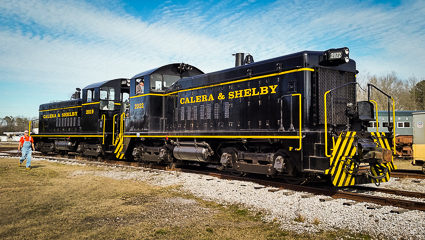
After more than four decades of service, the two locomotives were retired from the Army and acquired by the museum in 1995. Today, they represent an unusual combination of railroad and military history: American-built diesel locomotives that helped sustain military transportation during the Korean conflict and later found a new purpose hauling museum excursion trains.
Built for the U.S. Army
General Motors' Electro-Motive Division constructed Nos. 2019 and 2022 in 1951 as part of an order for 41 SW8 locomotives placed by the U.S. Army. Numbered 2000 through 2040, the locomotives were built between May and June 1951 at EMD's Plant No. 3 in Cleveland, Ohio.
The Army's purchase was the largest single order of SW8 locomotives from any customer, exceeding the orders placed by individual Class I railroads.
The SW8 was EMD's medium-horsepower switching locomotive, designed for moving railroad cars in yards, industrial facilities, and other locations where low-speed pulling power was more important than high-speed operation.
Each locomotive is powered by an eight-cylinder EMD 567 diesel engine producing 800 horsepower. The locomotives measure 44 feet, 5 inches from coupler to coupler and weigh approximately 230,000 pounds when fully loaded.
Railroads and the Korean War
When North Korean forces invaded South Korea in June 1950, the United States and other United Nations nations began sending troops, equipment, and supplies to support South Korea's defense. Rail transportation quickly became essential to moving those resources from the ports to the fighting front.
Korea already possessed an extensive railroad network developed during the period of Japanese rule. Japan had built the system in part to support its military operations in Manchuria, using standard-gauge track and knuckle couplers compatible with American railroad practices.
Following World War II, the Korean government assumed control of the network, which became known as the Korean National Railroad (KNR).
A Railroad System Under Strain
During the Korean War, the U.S. Army depended heavily on the KNR to transport troops and supplies from the port of Pusan to military operations farther north.
At the beginning of the conflict, the Korean National Railroad had approximately 300 serviceable steam locomotives and 6,000 railroad cars. Much of this equipment had been inherited from the Japanese railway system.
As military traffic increased, the available steam locomotives and rolling stock were stretched beyond their capacity. During the first year of the war, the Army recognized the need for additional motive power and began arranging for the purchase of new diesel locomotives.
Forty-One SW8s Bound for Korea
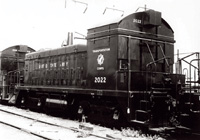
The Army's order for 41 EMD SW8s provided the additional motive power needed to support military railroad operations in Korea.
After construction in Cleveland, the locomotives were transported to New York Harbor, loaded aboard ships, and sent through the Panama Canal to Pusan, Korea.
When the diesels arrived, railroad operations were being conducted by the Army's 712th and 724th Transportation Railway Operating Battalions under the direction of the 3rd Military Railway Service.
The usual operating arrangement placed two American soldiers aboard each locomotive, accompanied by a Korean pilot familiar with local railroad conditions.
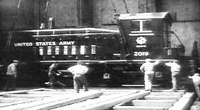
The trains carried troops, ammunition, equipment, and supplies to support military operations. Hospital trains also operated regularly, transporting wounded personnel away from the fighting and back toward the port at Pusan.
Nos. 2019 and 2022 served in this demanding environment from 1951 to 1953, contributing to the transportation system on which the military campaign depended.
Returning Home
Following the cease-fire in 1953, the Army returned most of its SW8 locomotives to the United States. Some remained in Korea for continued service with the Korean National Railroad.
No. 2019 was returned to EMD for reconditioning in September 1953. No. 2022 underwent rebuilding in June 1955.
Both locomotives subsequently resumed military service at installations throughout the United States, joining their sister locomotives in performing railroad switching and transportation duties on Army bases.
Final Military Service at Fort Campbell
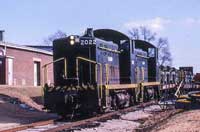
Nos. 2019 and 2022 spent their final years of military service at Fort Campbell, Kentucky, where they continued handling railroad traffic for the Army.
A photograph taken January 9, 1990, shows the two locomotives working together at Fort Campbell, pulling a train of High Mobility Multipurpose Wheeled Vehicles (HMMWVs).
After more than 40 years of military service, the locomotives were retired in the early 1990s.
A New Assignment in Alabama
The Heart of Dixie Railroad Museum acquired both locomotives through the federal government's surplus property program in 1995.
Their arrival gave the museum two substantial diesel-electric locomotives with an exceptional military history. Equipped for multiple-unit operation, Nos. 2019 and 2022 could operate together under the control of a single engineer.
As part of the museum's operating fleet, the former Army switchers have provided motive power for excursion trains on the Calera & Shelby Railroad, continuing their working careers long after their military retirement.
From Military Service to Museum Railroading
Few museum locomotives can claim a service history quite like that of Nos. 2019 and 2022. Built to meet the transportation demands of the Korean War, they crossed the Pacific, worked on a foreign railroad system under military control, returned to the United States, and continued serving the Army for decades.
At the Heart of Dixie Railroad Museum, their story continues as part of Alabama's railroad heritage. Their preservation connects visitors not only with the development of diesel-electric locomotives, but also with the important role railroads played in American military history.
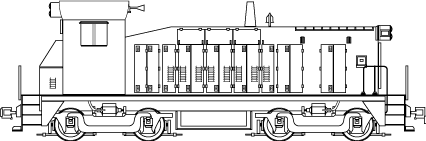
EMD SW8 Specifications
- Builder: General Motors Electro-Motive Division (EMD)
- Model: SW8 diesel-electric switcher
- Museum locomotives: Nos. 2019 and 2022
- Construction date: 1951
- Prime mover: EMD 567B, eight-cylinder, two-stroke diesel
- Aspiration: Roots-type supercharger
- Horsepower: 800
- Length: 44 feet, 5 inches over couplers
- Loaded weight: 230,000 pounds
- Track gauge: 4 feet, 8½ inches (standard gauge)
- Total SW8 production: 374 locomotives, September 1950–February 1954