Not every locomotive enters service with the railroad for which it was built. Baldwin S-8 No. 37, now preserved at the Heart of Dixie Railroad Museum, began its career as part of an order that never materialized. Originally constructed without an operator's cab, it was intended to work alongside another locomotive as a permanently paired switching unit.
Instead, the locomotive was modified and sold to United States Pipe & Foundry in Birmingham, Alabama, where it spent decades moving coal and railroad cars through one of the South's major industrial districts.
Its history includes service on the Mary-Lee Railroad, work at a North Birmingham coke plant, several changes in ownership and appearance, and eventual conversion for remote-control operation.
Built by Baldwin Locomotive Works
Baldwin Locomotive Works constructed No. 37 at its Eddystone, Pennsylvania, plant in April 1953, assigning it construction number 75836.
The locomotive was an S-8 diesel-electric switcher, one of 61 examples built by Baldwin between 1950 and 1954. Each S-8 was powered by an 800-horsepower, six-cylinder Baldwin Model 606 diesel engine with natural aspiration.
Designed for switching service, the S-8 provided the pulling power needed to move heavy railroad cars at relatively low speeds. Such locomotives were particularly useful at steel mills, mines, coke plants, and other industrial facilities where trains were frequently assembled, separated, and repositioned.
A Cow-and-Calf That Never Reached Its Customer
No. 37 was originally constructed as the cabless half, or calf, of a two-locomotive switching set intended for Oliver Iron Mining (OIM).
In a cow-and-calf arrangement, the cow is a conventional locomotive equipped with an operator's cab, while the calf has no cab of its own. The two locomotives are connected through multiple-unit controls, allowing one engineer to operate both engines from the cow's cab.
This arrangement provides the combined pulling power of two locomotives without requiring a separate operating cab and crew for each unit.
Baldwin constructed the pair in anticipation of an order from Oliver Iron Mining. The locomotives were painted in OIM colors and assigned numbers 1216A and 1216B.
However, Oliver Iron Mining elected to purchase locomotives from Electro-Motive Division (EMD) instead. Baldwin's two S-8s remained unused at Eddystone, and the pair ultimately became the final S-8 units built by the company.
No. 37 Receives a Cab
In January 1954, Baldwin shipped the cab-equipped locomotive to Armco Steel in Ashland, Kentucky, where it became No. 1201.
The cabless unit remained at Baldwin until later that year, when the company installed an operator's cab and prepared it for independent operation.
The rebuilt locomotive was then delivered to United States Pipe & Foundry (USP&F) in Birmingham, Alabama, which assigned it road number 37.
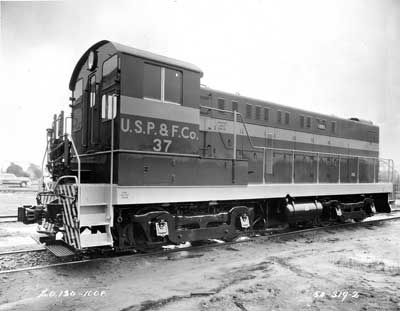
What began as the cabless half of an unsold locomotive pair was now a conventional industrial switcher, ready for a long working career in Alabama.
Working the Mary-Lee Railroad
No. 37 initially worked alongside four other Baldwin S-8 locomotives, numbered 33 through 36, primarily handling daily coal trains on the Mary-Lee Railroad.
All five S-8s were equipped for multiple-unit operation, allowing two or more locomotives to be controlled together when additional pulling power was required.
The Mary-Lee Railroad served industrial operations associated with the Birmingham area's coal and iron industry. Moving coal reliably was essential to keeping the coke ovens and blast furnaces supplied with the materials needed for steelmaking.
Service at the North Birmingham Coke Plant
By 1964, No. 37 was generally assigned to the No. 5 blast furnace at the east end of the North Birmingham coke plant.
During the latter part of the 1960s, the locomotive became the plant's regular switcher, moving railroad cars within the facility as production required.
By 1972, its duties had shifted to the coal yard, where it was used for weighing and spotting railroad cars. These tasks required precise, low-speed movements to position loaded cars for weighing, unloading, and other operations.
Changing Paint Schemes
Photographs indicate that No. 37 wore a blue-and-white Missouri Pacific paint scheme from approximately 1965 through 1972.
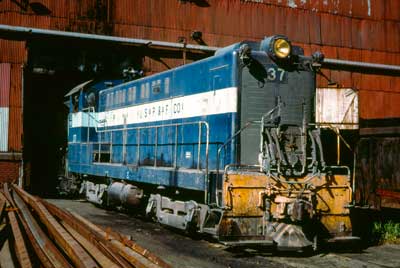
In 1972, the locomotive was repainted in an orange-and-white scheme.
Jim Walter Resources and Remote-Control Operation
Jim Walter Resources gained control of United States Pipe & Foundry in 1969. No. 37 was eventually relettered for Jim Walter Resources, Inc., reflecting the change in ownership.
At some point during its later working career, the locomotive was equipped for remote-control operation on the Jefferson Warrior Railroad, part of the Jim Walter Resources operation.
Remote-control equipment allowed switching movements to be controlled from a location outside the locomotive cab, a useful capability in industrial environments where cars had to be positioned repeatedly within a confined area.
Preservation at the Heart of Dixie Railroad Museum
After No. 37 was removed from service, it was donated to the Heart of Dixie Railroad Museum along with two former United States Pipe & Foundry cabooses, Nos. 99X and 100X.
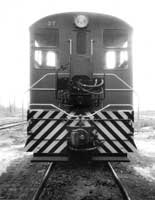
These pieces of equipment preserve a shared connection to the industrial railroads that served Birmingham's coal, iron, and steelmaking operations.
No. 37 is particularly noteworthy for its unusual origins. Built as a cabless locomotive for a customer that ultimately chose another manufacturer, it was modified into an independent switcher and went on to spend decades performing the demanding work for which Baldwin designed the S-8.
Its preservation provides a tangible link to both the final years of Baldwin diesel locomotive production and the industrial railroad operations that helped shape Alabama's economy.