Long before diesel locomotives became the standard for industrial switching, many factories, mines, and steelmaking facilities relied on small electric locomotives to move railroad cars around their properties. Powered by electricity supplied through overhead wires, these compact machines could handle demanding work in places where a full-sized steam locomotive was impractical.
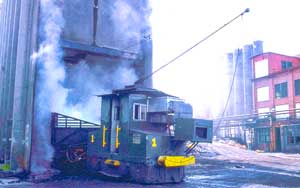 The Heart of Dixie Railroad Museum preserves two examples of this early industrial technology: General Electric switchers Nos. 1 and 2, originally built for service at the Central Iron and Foundry Company's Empire Coke Plant in Holt, Alabama, near Tuscaloosa.
Built sometime between 1903 and 1912, the locomotives worked around the plant's Semet-Solvay battery coke ovens, moving railroad equipment as part of the coke-making operation. They were also known as trolley locomotives because they drew electrical power from overhead trolley wires.
Electric Power for Industrial Work
As built, each locomotive was equipped with two General Electric Type 57 traction motors and a GE K-6-A master controller. The traction motors supplied the power needed to move the locomotive and its load, while the master controller allowed the operator to regulate its speed and direction.
Unlike steam or diesel locomotives, these switchers did not carry their own fuel supply or generate their own propulsion power. Instead, they collected electricity from an overhead trolley-wire system, making them well suited to industrial operations where the necessary electrical infrastructure was already installed.
Two of Ten
General Electric constructed ten trolley locomotives for various Semet-Solvay installations, including units associated with the Empire Coke Plant.
Unfortunately, GE's surviving builder records do not identify the exact destination of each locomotive. Because the Empire Coke Plant opened in 1903, it is possible that the first six Semet-Solvay locomotives equipped with GE Type 57 motors were delivered there.
Without more complete records, however, the precise construction dates and original delivery assignments of the museum's two locomotives remain uncertain.
From Boxcabs to Steeplecabs
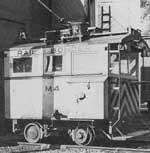 Although the museum's locomotives are now classified as steeplecab switchers, they were originally built with boxcab bodies. A boxcab locomotive has a relatively tall, enclosed body extending over much of its frame, while a steeplecab has a raised central operator's cab with lower equipment compartments at each end.
Sometime during the 1940s or 1950s, the original boxcab bodies were modified into their present steeplecab configuration.
The change appears to have been made to accommodate air compressors and reservoirs installed to improve the locomotives' braking capabilities. As originally built, the switchers did not have conventional air brakes, relying instead on regenerative braking.
The addition of air-brake equipment provided another means of controlling the locomotives and their loads during industrial switching operations.
Preserving an Earlier Era of Electric Railroading
General Electric switchers Nos. 1 and 2 represent an often-overlooked chapter of railroad history. While large steam and diesel locomotives handled mainline freight and passenger trains, small industrial electric locomotives performed essential work within factories and industrial complexes.
The museum's two switchers preserve a connection to Alabama's iron and steel industry and to the early development of electric locomotive technology. Their unusual appearance also reflects the practical modifications made to industrial equipment over decades of service.