Before motorized maintenance vehicles became commonplace, railroad workers often relied on their own muscle power to travel along the tracks. Among the most ingenious solutions was the railroad velocipede, a lightweight, human-powered vehicle resembling a combination of an early bicycle and a railroad handcar.
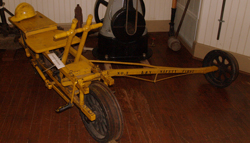 Designed to carry one or two people, a velocipede allowed railroad employees to travel considerable distances along the rails without requiring a locomotive or a full-sized handcar. The operator supplied the power, while a second seat accommodated another railroad official or section hand.
The Heart of Dixie Railroad Museum's velocipede was donated by the Louisville & Nashville Railroad (L&N) in October 1996. Its history is closely associated with an unusual occupation at Birmingham's Boyles Yard: the railroad lamplighter.
The Boyles Yard Lamplighter
According to accounts of its history, the museum's velocipede was used by the lamplighter at the L&N's Boyles Yard in Birmingham, Alabama.
Before electric switch indicators became common, kerosene lanterns mounted on railroad switches helped train crews determine how the switches were lined. The lamps displayed red for a diverging route and green for the main route.
Keeping those lamps burning was the lamplighter's responsibility. He traveled the miles of yard trackage checking the lanterns, replenishing their kerosene, and replacing wicks when necessary.
The velocipede made the job considerably easier. A can of kerosene rode on the rear platform, while spare wicks were carried in a small box mounted between the frames at the front.
If a train approached, the lamplighter simply lifted the velocipede off the rails, waited for the train to pass, and returned it to the track before continuing his rounds.
Powered by Muscle
The velocipede was propelled primarily through a rowing motion, assisted by foot pedals. Its lightweight construction made it practical for one person to operate and handle.
The frame, wheels, and outrigger were made of wood, with the frame secured by bolts. An iron brace strengthened the outrigger, which could be adjusted or removed as needed.
The axles and crankshaft were made of iron, while the tires were cast iron. The crank and pedals were manufactured from malleable iron.
Weighing approximately 140 pounds, the entire vehicle was light enough for one person to lift from the tracks or turn around when necessary. This was particularly important in busy railroad yards, where the velocipede needed to be quickly cleared from the path of approaching trains.
Early Railroad Velocipedes
Several manufacturers supplied velocipedes to American railroads during the late 19th and early 20th centuries.
The Sheffield Company of Three Rivers, Michigan, was among the earliest. In 1878, company founder George Sheffield recognized the potential of fitting velocipedes with flanged wheels for railroad use.
The Kalamazoo Railway Supply Company of Kalamazoo, Michigan, began producing railroad velocipedes in the early 1880s and became known for the quality of its machines.
The manufacturer of the Heart of Dixie Railroad Museum's velocipede has not been positively identified.
A Small but Important Railroad Tool
Although modest compared with locomotives and other railroad equipment, the velocipede filled an important need. It gave individual employees a practical means of traveling along the railroad while carrying the tools and supplies needed for their work.
The museum's L&N velocipede preserves a connection to both early railroad maintenance technology and the everyday duties of workers whose efforts helped keep railroad operations running safely.