Not every railroad maintenance job required an enormous wrecking derrick or a large crew. For everyday track repairs, construction, and material handling, railroads often relied on smaller, more versatile machines capable of performing several jobs with minimal support.
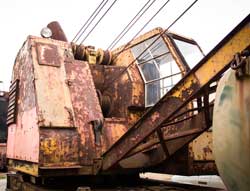 One of the most useful was the Burro crane, a compact, self-propelled machine that combined the lifting power of a crane with the mobility of a small locomotive. Its versatility made it particularly well suited to maintenance-of-way work, where crews frequently needed to move equipment and materials along the railroad.
The Heart of Dixie Railroad Museum's Burro Model 15 Crane was built in June 1949 by the Cullen-Friestedt Company of Chicago, Illinois. Carrying serial number 15208, the crane has a lifting capacity of 12 tons and is powered by a three-cylinder Detroit Diesel engine.
A Versatile Railroad Workhorse
Despite its relatively small size, the Model 15 was capable of performing a surprising variety of jobs. In addition to lifting loads weighing up to 12 tons, the self-propelled crane had enough power to pull one or even two fully loaded railroad cars.
This combination of capabilities made the Burro particularly useful for light-duty construction and maintenance along railroad lines. Crews could travel to a work site, move materials, and perform lifting operations without necessarily requiring a separate locomotive or additional heavy equipment.
A Railroad's Swiss Army Knife
Much of the Burro crane's versatility came from its ability to accept different attachments. Depending on the equipment installed, the same machine could be used for digging, lifting, and even snow removal.
This adaptability helped make Burro cranes valuable tools for railroad maintenance crews. Rather than maintaining separate machines for every task, railroads could use one compact crane for a wide range of jobs.
The basic Burro crane design proved remarkably durable, remaining in use and production in various forms well into the 1980s.
The Pack Animal of the Industry
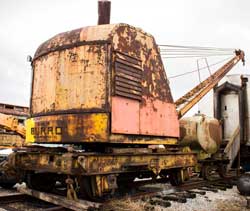 The name Burro was no accident. Cullen-Friestedt borrowed it from the hardy pack animals of the American West, known for their strength, endurance, and ability to carry heavy loads through difficult terrain.
It was a fitting name for a compact railroad machine designed to perform demanding work with relatively little assistance. The company eventually adopted the advertising slogan "Pack Animal of the Industry," emphasizing the crane's strength and versatility.
The Model 15 was the first in the Burro series. As the product line developed, Cullen-Friestedt introduced additional models numbered 20, 30, 40, and 50.
Today, the museum's 1949 Burro Model 15 represents an important part of railroad history that often goes unnoticed. While locomotives and passenger cars attract much of the attention, machines like the Burro helped maintain the tracks and infrastructure that kept trains moving.