Few pieces of railroad equipment have experienced as many changes in purpose as the Heart of Dixie Railroad Museum's four former U.S. Army guard cars. Built during World War II to prepare meals aboard military trains, these cars later served as mobile guardhouses protecting classified shipments. Their final military assignment was equally unusual: supporting railroad cars equipped with aircraft flight simulators.
The museum preserves four of these remarkable cars: G-51, G-53, G-54, and G-64. Their history spans nearly half a century of military railroad operations, from wartime troop transportation to the specialized requirements of the Cold War.
Built to Feed an Army
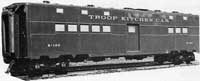 American Car & Foundry built cars G-51, G-53, and G-54 in 1943 as troop kitchen cars. They were among 440 such cars constructed for use on American railroads during World War II.
The fourth car, G-64, was built in 1944 as a hospital kitchen car for the U.S. Army, originally carrying the number USA 8751.
The cars were owned by the Defense Plant Corporation and operated by the Pullman Company for the military under agreements with the railroads over which they traveled.
Each car measured 54 feet, 2½ inches over the couplers, 9 feet, 11½ inches wide, and 13 feet, 6½ inches high. Their original weight was 77,500 pounds, or 38.75 tons.
As built, the cars were equipped with Vapor steam heating, an air-pressure water system, and battery-powered lighting. Their original trucks used friction bearings, although the museum's cars now ride on high-speed passenger trucks equipped with Hyatt roller bearings.
Inside the Rolling Kitchens
Approximately two-thirds of each car was devoted to food preparation and storage. Equipment included a work table, utensil drawers, cupboards, refrigerator, two large sinks, water tanks, a bread locker, and a meat-cutting table.
Cooking was performed on two large cast-iron, coal-fired Army ranges installed in tandem. Fuel storage included a wood bin and a half-ton coal box filled through a rooftop hatch.
The remaining third of the car contained facilities for the crew, including a shower, toilet, folding sink, and additional water tanks.
Military Identification
The kitchen cars originally wore standard military olive-drab paint with white lettering. The words UNITED STATES ARMY appeared in five-inch letters above the side doors, while individual car numbers were displayed in four-inch characters above each truck.
The designation KITCHEN CAR appeared to the right of each side door, with a ten-inch circular insignia identifying the military branch to which the car was assigned on the opposite side. Smaller identification lettering appeared on the end doors.
From Kitchens to Guard Cars
Between April and August 1953, the Army accepted delivery of 89 new dual-purpose troop and hospital kitchen cars built by the St. Louis Car Company. With newer equipment available, the older World War II kitchen cars were no longer needed in their original configuration.
 However, the Army had another requirement: specially equipped railroad cars to accompany classified military shipments. The surplus kitchen cars were suitable for conversion into mobile guardhouses, providing accommodations and support facilities for the personnel assigned to protect sensitive cargo.
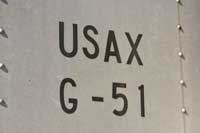
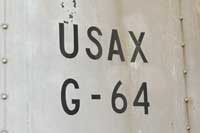
The conversions were performed at Army facilities. The resulting guard cars carried USAX reporting marks and numbers beginning with the prefix G-.
Records indicate that cars G-10 through G-60 were converted from troop kitchen cars in 1964. G-64 followed in 1965. During that year, the former USA 8751 was still listed in the Official Register of Passenger Train Equipment as the only 1944-built hospital kitchen car remaining on the Army roster.
At conversion, G-51, G-53, and G-54 had friction bearings, while G-64 had roller bearings. All four had roller bearings when acquired by the museum, suggesting that the trucks were subsequently standardized to simplify maintenance.
A Mobile Home for Security Crews
Conversion into guard cars required substantial interior modifications. The original kitchen arrangements were removed, and the cars were divided into four principal functional areas: crew support and dining facilities, an open area between the side doors, crew restroom and bathing facilities, and a soundproofed utility room containing the generator and mechanical equipment.
Some cars retained four water tanks while others had two, although their total water capacities remained the same.
Kitchen, Dining, and Crew Facilities
 The crew support area measured 23 feet, 10 inches. In place of the original coal-fired ranges and kitchen equipment, the rebuilt cars received a stainless steel electric range and oven, a single-basin stainless steel sink, and a storage cabinet with three drawers.
Other equipment included a coffee urn, electric refrigerator/freezer, two fixed dining tables with bench seats, overhead water tanks, a utility locker, a lounge seat, and a gun cabinet. Shower, lavatory, and toilet facilities were also provided.
The conversions substantially changed the exterior appearance. Of the original twelve windows, only six remained, three on each side at the end opposite the utility room. The remaining windows and side ventilation openings were covered with metal plates.
Sleeping Accommodations
Beyond the center-door corridor was a crew berthing area approximately 14 feet long. A full partition and accordion-style folding door separated this space from the kitchen and dining area.
Sleeping accommodations consisted of three Glennan triple-tier adjustable berth units, providing nine berths. Each berth had its own 110-volt reading light. A large sliding-door locker provided storage for clothing and personal belongings.
Self-Contained Mechanical Systems
The guard cars were designed to operate with considerable independence, providing their crews with electricity, heating, cooling, and water while accompanying military shipments.
Generator and Electrical Power
A soundproof partition separated the berthing area from the generator room, which measured approximately 9 feet, 6 inches long. Access was through a center-aisle doorway equipped with double sound-reducing doors.
The room housed a diesel engine driving a 21.5-kilowatt generator, air-conditioning equipment, a Vapor Aquazone heating and water-heating unit, electrical controls, a 12-volt battery, and temperature controls.
Exterior louvers supplied air for the diesel engine, heating equipment, and air-conditioning system. Both the diesel engine and Aquazone unit exhausted through the roof.
Fuel was supplied from tanks beneath the cars. The generator engine burned diesel fuel, while the Aquazone heater originally used fuel oil. The Aquazone units were later converted to propane operation.
In addition to their onboard generators, the cars could receive external electrical power through 115-volt single-phase or 208-volt three-phase connections. An internal selector switch allowed the appropriate power source to be chosen.
Heating and Air Conditioning
Space heating was provided by a closed-loop system using overhead and baseboard finned radiators. Two electric pumps circulated a freeze-protected mixture of 50 percent ethylene glycol and 50 percent water through the system.
Individual radiator elements could be controlled independently, allowing different areas of the car to be heated as needed. Some cars, including G-51 through G-54, later received supplemental electric heaters.
Air conditioning was supplied by a five-ton, 208-volt, three-phase unit capable of circulating approximately 1,500 cubic feet of air per minute through a recirculating duct system.
The Vapor Aquazone unit used heat exchangers to supply both wash water and space heating. Heat could be obtained from a trainline heating system or the Aquazone burner itself.
Three adjustable mercury thermostats controlled the interior temperature, one for heating and two for cooling.
Lighting and Equipment Differences
Four centerline fluorescent ceiling fixtures provided general illumination in the generator room, berthing area, and lounge. Incandescent fixtures illuminated the kitchen and dining areas, while emergency lighting was installed in each compartment.
Although the converted cars shared a common general arrangement, their equipment was not entirely identical. Cars G-13 through G-18 and G-64 used different refrigerators, ranges, water pumps, faucets, and braking equipment from cars G-50 through G-63. In most cases, the differences involved equipment manufacturers rather than the basic design.
A New Assignment: Supporting Flight Simulators
 The guard cars eventually received another specialized assignment at Hill Air Force Base in Utah. There, they served as companion and crew-support cars for mobile military flight simulators housed in former Pullman sleeping cars.
These simulator cars contained KC-135A flight simulators, allowing military personnel to conduct training at different installations.
Each guard car was permanently paired with a particular simulator car, providing accommodations for personnel and carrying the equipment necessary to support its operation.
For this assignment, some of the sleeping berths were removed and replaced with a workbench, lower cabinets, drawers, and overhead storage. These spaces carried spare parts for both the guard car and its associated simulator.
The inventory was extensive enough to permit repairs to defective or damaged components while the equipment was traveling or stationed at military facilities.
Another important modification allowed the guard car to supply three-phase electrical power directly to its companion simulator car. Heavy electrical cables connected receptacles beneath and at the ends of the two cars.
In this final role, the former kitchen cars had become mobile support facilities, supplying personnel accommodations, electrical power, and maintenance resources for sophisticated military training equipment.
Acquisition by the Heart of Dixie Railroad Museum
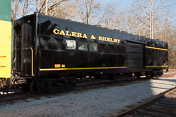 Guard cars G-51, G-53, G-54, and G-64 were declared surplus by the United States Government in August 1988.
The Heart of Dixie Railroad Museum purchased all four cars as surplus military equipment in the early 1990s. At the time, they were stored at an Air Force base in Utah and retained essentially the same configuration used during their flight simulator assignments.
Despite their years of military service, the cars required only minor inspections and certification before they could be shipped to Alabama on their own wheels.
The Four Cars at the Museum
Since their arrival at the Heart of Dixie, the four cars have followed different paths, reflecting the museum's continuing need for workshop space, equipment storage, and support facilities.
Guard Car G-51
G-51 has been undergoing modernization for use as the museum's passenger-car shop office, sign shop, and upholstery work area. The car is positioned on a siding adjacent to the shop building.
Guard Car G-53
 G-53 is not presently assigned to a specific museum function. It remains on a panel track while a decision regarding its future use is pending.
Guard Car G-54 — HEP-54
G-54 underwent the most substantial transformation of the four cars. The museum removed its interior furnishings and converted it into a head-end power car, now designated HEP-54.
In this role, the car provides electrical power for the museum's passenger equipment and remains an important part of regular excursion operations.
Guard Car G-64
G-64 serves as supplemental storage for the museum's Boone Library. The car is positioned on a panel track beside the former Woodlawn Depot, which houses the library.
Nearly Half a Century of Military Railroad History
From preparing meals for wartime troop trains to accompanying classified shipments and supporting mobile flight simulators, these four cars demonstrate the remarkable adaptability of railroad equipment.
Their preservation at the Heart of Dixie Railroad Museum also illustrates a lesser-known side of American railroad history: the extensive use of rail transportation by the United States military long after World War II.
Although their military assignments have ended, the cars continue to serve the museum in different ways, extending a history of practical service that began more than eight decades ago.