When a locomotive derailed or a freight train left the tracks, getting the railroad operating again required more than manpower and determination. It often called for one of the most powerful machines in the railroad's equipment fleet: a wrecking derrick.
These enormous rail-mounted cranes were the heavy lifters of the railroad industry. Working alongside specially trained wrecking crews, they could raise derailed locomotives, lift overturned freight cars, and clear wreckage from the tracks. Their work was demanding and sometimes dangerous, but essential to restoring railroad service as quickly and safely as possible.
Unlike ordinary cranes, railroad wrecking derricks traveled directly over the tracks to reach their assignments. They were frequently accompanied by boom cars, which supported the crane's long boom during travel, and other equipment carrying tools, supplies, and crew accommodations. Together, these cars formed part of a railroad's wreck train, ready to respond when needed.
The Heart of Dixie Railroad Museum preserves one of these impressive machines: a 150-ton wrecking derrick built in 1926 by Industrial Works for the Southern Railway. Originally numbered D5989, this massive crane represents an era when railroads maintained their own specialized equipment and crews to respond to derailments and other heavy lifting assignments.
Built for Heavy Lifting
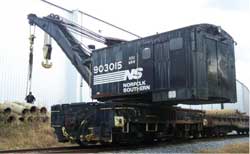 With a rated lifting capacity of 150 tons, the derrick was designed for demanding railroad work, including lifting locomotives and rolling stock during recovery operations.
Originally steam-powered, the derrick was later converted to diesel power, extending its usefulness as railroad technology evolved. Unlike many railroad cranes that required a locomotive to move them, this derrick was self-propelled and capable of traveling at speeds up to 25 mph.
Southern Railway Service
During its working life, the derrick carried several numbers. Built as Southern Railway D5989, it was later renumbered D76 and subsequently 903015.
The crane worked out of Gentilly Yard in New Orleans, Louisiana, where it served as part of the railroad's heavy equipment fleet.
Preservation at the Heart of Dixie
Following its railroad service, Norfolk Southern donated the derrick to the Heart of Dixie Railroad Museum, preserving an example of the specialized machinery used to maintain and operate America's railroads.
Its massive boom and heavy-duty construction offer visitors a look at the equipment railroad crews depended upon when ordinary locomotives and maintenance machines were not enough for the job.