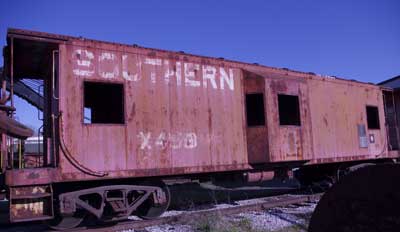
 Cabooses X458 and X461 were built in 1970 as part of order NCP-59 by Gantt Manufacturing of Greenville, South Carolina, for the Southern Railway. They were assigned road numbers X458 and X461. When delivered, X458 was the 59th caboose and X461 the 62nd in the order series. Gantt Manufacturing eventually delivered 113 cabooses in the series, carrying road numbers X400 through X512.
Road Cabooses
X458 and X461 were designated as over-the-road cabooses and were equipped accordingly. Both came with radios and electrical appliances. Each caboose provided its own electrical power through an axle-mounted generator. With this equipment, the total weight of each caboose was 52,900 pounds.
Bay-Window Cabooses
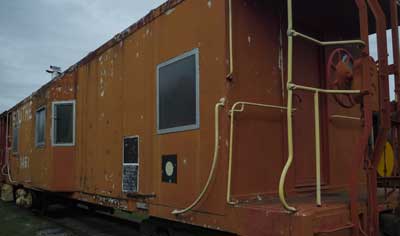 In a bay-window caboose, crew members monitor their train from the middle of the car, where sections of the sides project outward much like a bay window on a house. This distinctive feature gives the bay-window caboose its name.
A traditional cupola-type caboose provided a more restricted view along the sides of the train and also presented a falling hazard for crew members. The Baltimore & Ohio Railroad began building all of its cabooses as bay-window models in 1930.
Eventually, the bay-window caboose became favored by many railroads because the design eliminated the additional overhead clearance required by a cupola-equipped caboose when passing through tunnels and beneath overpasses.
Not a "Yellow Belly"
Visually, X458 and X461 are easily distinguished from Southern Railway cabooses designated for local service. Local-use cabooses had their bay windows painted yellow. This distinctive paint scheme earned those cabooses the nickname "Yellow Bellies." The museum's X201 is an example of a Southern Railway local-service caboose with this paint scheme.