For generations, railroad depots served as gateways to the communities along America's railroads. They were places where passengers began their journeys, freight arrived for local businesses, and station agents kept trains and commerce moving.
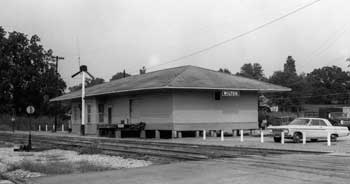 The Wilton Depot, now preserved at the Heart of Dixie Railroad Museum in Calera, Alabama, is an example of these once-essential community landmarks. Originally serving the Southern Railway in Wilton, approximately 10 miles west of Calera, the building continues its railroad tradition as the museum's depot and ticket office.
A Community with Many Names
Wilton's railroad history dates to 1853, when the Alabama and Tennessee Railroad laid the first rails through the community, then known as Woods, Alabama. The town would undergo several name changes before becoming Wilton.
The railroad serving the community also changed names over the years. Among its predecessors were the East Tennessee, Virginia and Georgia Railroad (ETG&V), the Selma, Rome and Dalton Railroad, and the Brierfield, Blocton and Birmingham Railroad, commonly called the "3B Railroad."
In 1894, financier J. P. Morgan consolidated the ETG&V and Richmond & Danville Railroad into the Southern Railway, which later became part of Norfolk Southern.
A Combination Depot
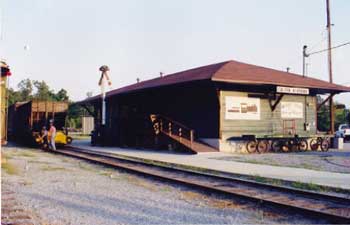 The Wilton Depot was built as a combination depot, a station designed to handle both passengers and freight under one roof. Although its exact construction date is unknown, similar Southern Railway depots built in the surrounding area date from approximately 1900 to 1910.
The freight section included a large storage area with two rolling doors opening onto a wraparound loading dock. This arrangement allowed goods to be moved between freight cars, the depot, and local businesses.
The passenger section reflected the racial segregation laws and practices of the Jim Crow era. Separate waiting rooms were provided for White and Black passengers, with the waiting room for Black passengers being smaller. This division remains an important part of the building's history and the story of railroad travel in the segregated South.
The Station Agent's Office
Between the freight and passenger sections was the station agent's office, the operational center of the depot. A ticket window opened into the passenger waiting area, while a separate door provided access to the freight storage room.
One of the building's distinctive features was a bay window extending approximately three feet toward the tracks. This allowed the station agent to observe approaching trains and activity along the railroad.
The bay window also housed controls for the station board signal, mounted on a mast outside the office. The signal communicated to approaching trains whether they were required to stop at the station or could continue without stopping.
A New Home in Calera
In January 1984, the Wilton Depot was moved approximately 13 miles east to the Heart of Dixie Railroad Museum in Calera, where it began a new chapter as the museum's depot.
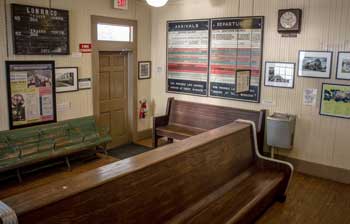 Now known as the Calera Depot, the building houses exhibits and artifacts documenting Alabama's railroad heritage. Visitors can purchase tickets for excursions aboard the museum's Calera & Shelby Railroad through the depot's original-style ticket window.
Among the artifacts displayed inside are wooden passenger benches and arrival and departure boards from Birmingham's former Terminal Station, along with other items representing the history of rail transportation in Alabama.
More than a century after depots of its design first appeared along Southern Railway lines, the Wilton Depot continues to welcome railroad passengers. Its preservation offers visitors a connection to the everyday operations, architecture, and history of Alabama's railroads.